Choosing a medical component supplier involves more than simply finding a manufacturer capable of producing a part according to a technical drawing.
For an OEM, selecting the right partner means assessing manufacturing expertise, process control, traceability and the ability to ensure consistent, repeatable production over time.
This is particularly important in precision micromachining, where complex geometries, tight tolerances and specific materials require a structured manufacturing approach.
What should a medical device manufacturer consider when selecting a contract manufacturing partner?
1. ISO 13485 certification and Quality Management
ISO 13485 certification is an important evaluation criterion for companies operating in the medical device supply chain.
It demonstrates the implementation of a quality management system that meets the applicable requirements of the standard, with particular emphasis on process control, documentation and risk management.
However, certification should not be considered the only selection criterion.
An OEM should also assess how the supplier applies its quality management system in practice, including manufacturing operations, dimensional inspections, nonconformity management and engineering changes.
OROS operates under an ISO 9001 and ISO 13485 certified quality management system, supporting its precision micromachining activities for the medical sector.
2. Capability to manufacture complex geometries and meet tight tolerances
Not all medical components present the same manufacturing challenges.
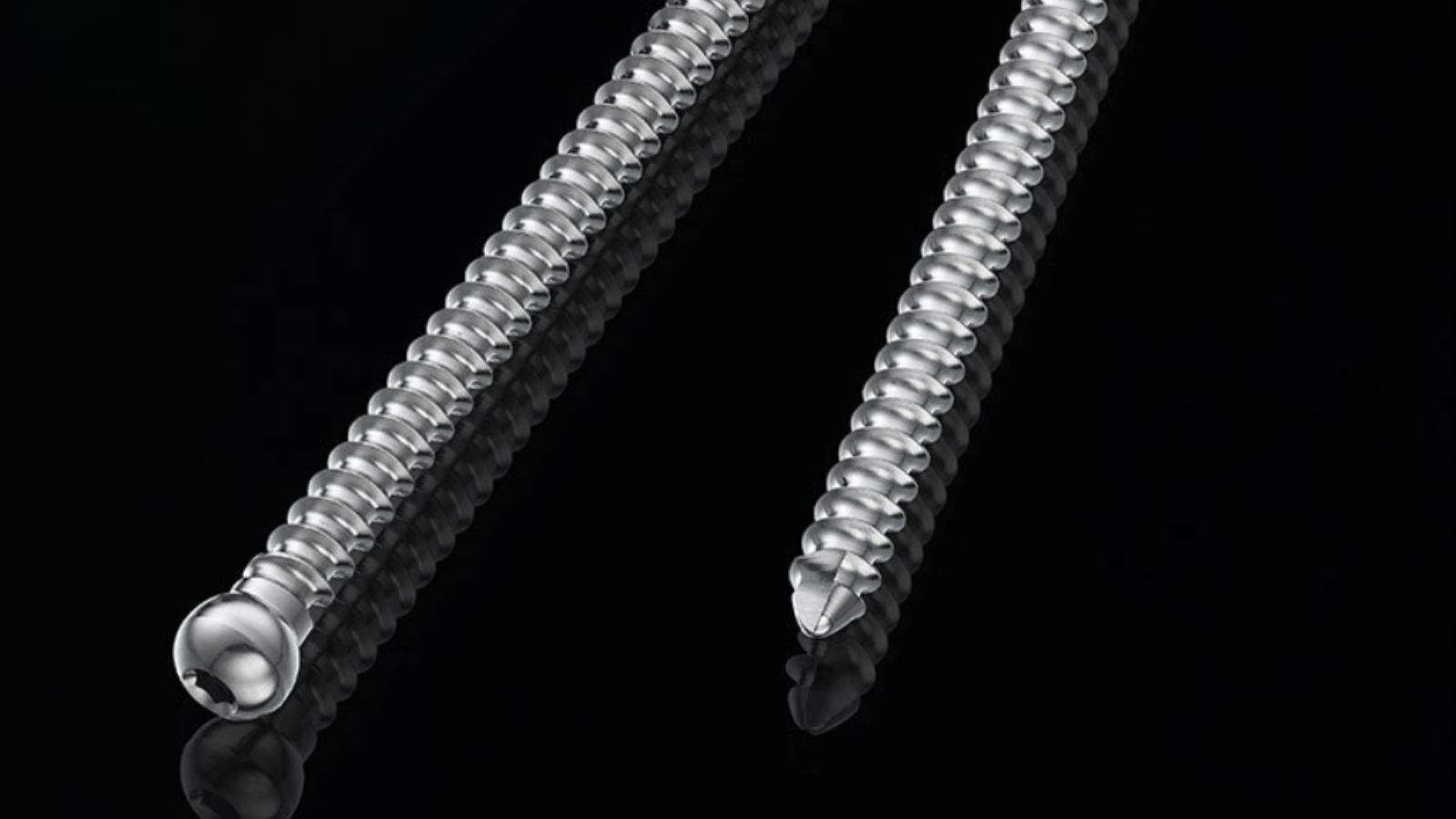
An orthopedic screw, for example, may require complex threads, specific profiles, mating features and particularly deep axial drilling.
When evaluating a supplier, OEMs should therefore consider not only component dimensions but also the complexity of the manufacturing operations involved.
A significant example is OROS’s capability to manufacture cannulated orthopedic screws up to 250 mm in length, where deep axial cannulation represents a distinctive manufacturing challenge.
Producing these geometries requires expertise in tooling selection, machining parameter optimization and process control.
3. Experience with materials used in medical applications
Titanium and stainless steels used in medical applications have different characteristics in terms of machinability, tool performance and surface finish.
The selection of cutting parameters and machining strategies must take into account the material properties and the specifications required by the customer.
For this reason, an OEM should assess a potential supplier’s experience with the specific materials intended for the project.
OROS processes materials including Grade 5 titanium and stainless steels for medical applications, manufacturing precision components according to agreed technical specifications.

4. Pre-Series production and manufacturing feasibility assessment
Manufacturing an initial component that meets specifications does not necessarily demonstrate that the process is suitable for continuous production.
Before starting serial production, it is important to verify that machining strategies, cycle times, inspection procedures and manufacturing resources are consistent with the expected production volumes.
Pre-series production therefore provides an opportunity to assess process repeatability and address potential issues before regular production begins.
OROS prioritises pre-series projects intended to lead to ongoing production, rather than isolated prototype or sampling requests without a clear industrial production perspective.
This approach allows technical resources to be focused on projects with a genuine need for industrialisation.
5. Traceability and revision Control
In the manufacturing of components for the medical sector, effective management of technical information is essential.
A supplier must be able to correctly identify applicable specifications, drawing revisions and the references required for batch traceability.
Particular attention must be paid to design changes: even a seemingly minor modification can affect machining operations, tooling or inspection methods.
Documented procedures for managing technical drawings, revisions and inspections help reduce the risk of errors throughout the manufacturing process.
4. Pre-Series Production and Manufacturing Feasibility Assessment
Manufacturing an initial component that meets specifications does not necessarily demonstrate that the process is suitable for continuous production.
Before starting serial production, it is important to verify that machining strategies, cycle times, inspection procedures and manufacturing resources are consistent with the expected production volumes.
Pre-series production therefore provides an opportunity to assess process repeatability and address potential issues before regular production begins.
OROS prioritises pre-series projects intended to lead to ongoing production, rather than isolated prototype or sampling requests without a clear industrial production perspective.
This approach allows technical resources to be focused on projects with a genuine need for industrialisation.
5. Traceability and Revision Control
In the manufacturing of components for the medical sector, effective management of technical information is essential.
A supplier must be able to correctly identify applicable specifications, drawing revisions and the references required for batch traceability.
Particular attention must be paid to design changes: even a seemingly minor modification can affect machining operations, tooling or inspection methods.
Documented procedures for managing technical drawings, revisions and inspections help reduce the risk of errors throughout the manufacturing process.
6. Manufacturing capacity and supply continuity
For an OEM, unit cost is not the only relevant economic consideration.
Delivery predictability, available manufacturing capacity and material management also affect supply chain reliability.
The assessment should therefore include specific questions:
Does the supplier have machinery suitable for the required geometries?
Can recurring production runs be scheduled?
Is it possible to share an annual production forecast?
Can inventory management and delivery release arrangements be agreed upon?
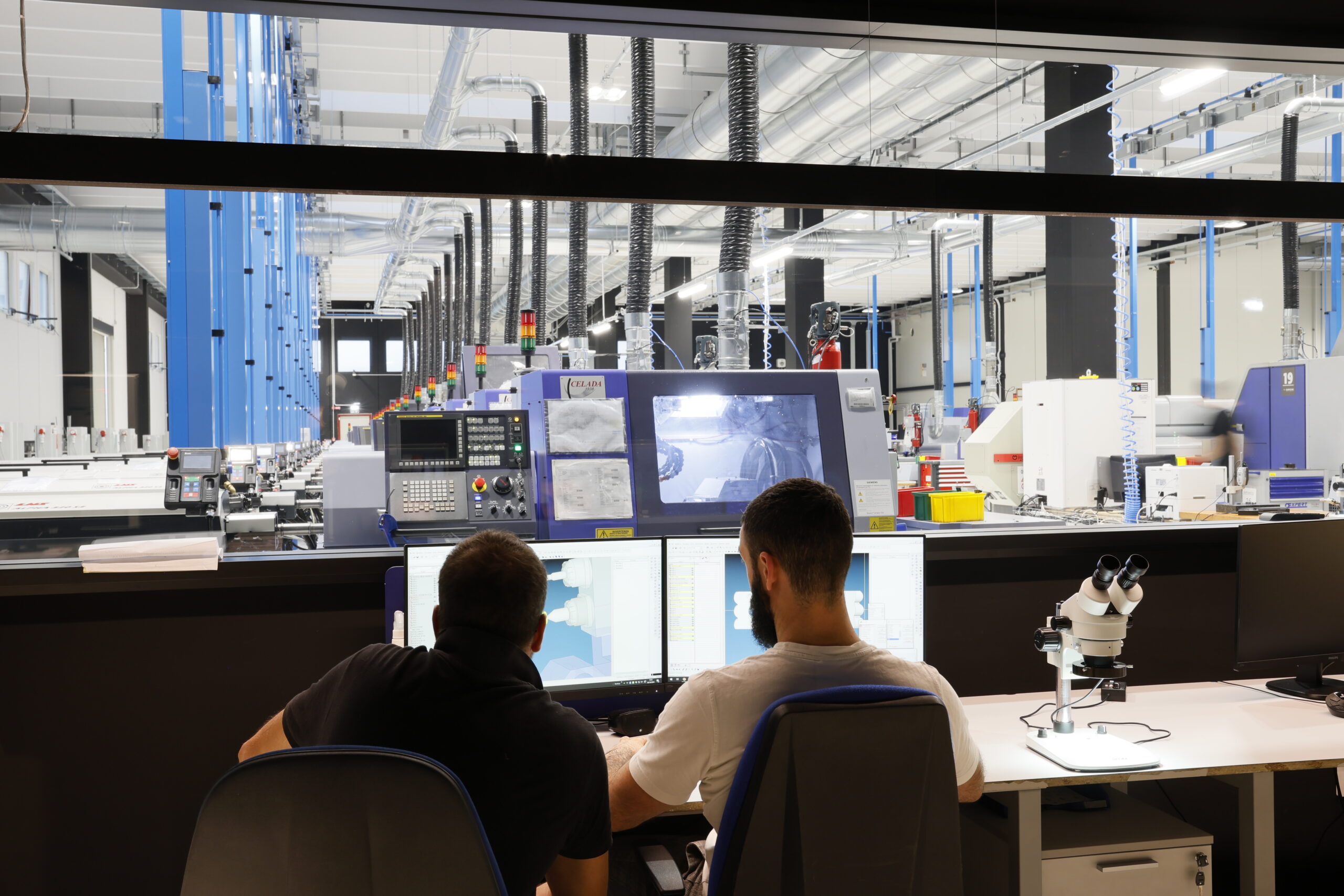
OROS operates a manufacturing facility equipped with 23 CNC machines and considers collaborative planning an important tool for organising machining operations, material procurement and deliveries.
Having access to a production forecast makes it possible to assess the industrial feasibility and long-term sustainability of a project more accurately.
7. Qualifying a second manufacturing source
Relying on a single supplier for the production of a component can create vulnerabilities within the supply chain.
For this reason, some OEMs consider qualifying a second manufacturing source to improve supply continuity and reduce dependence on a single production partner.
However, qualifying an additional supplier requires a structured process.
Technical compatibility, manufacturing capacity, documentation requirements and the necessary verification activities must be assessed in accordance with the manufacturer’s procedures.
A partner specialising in precision micromachining for medical applications can support this process by providing manufacturing expertise and technical information relevant to the qualification assessment.
From supplier selection to Long-Term manufacturing partnership
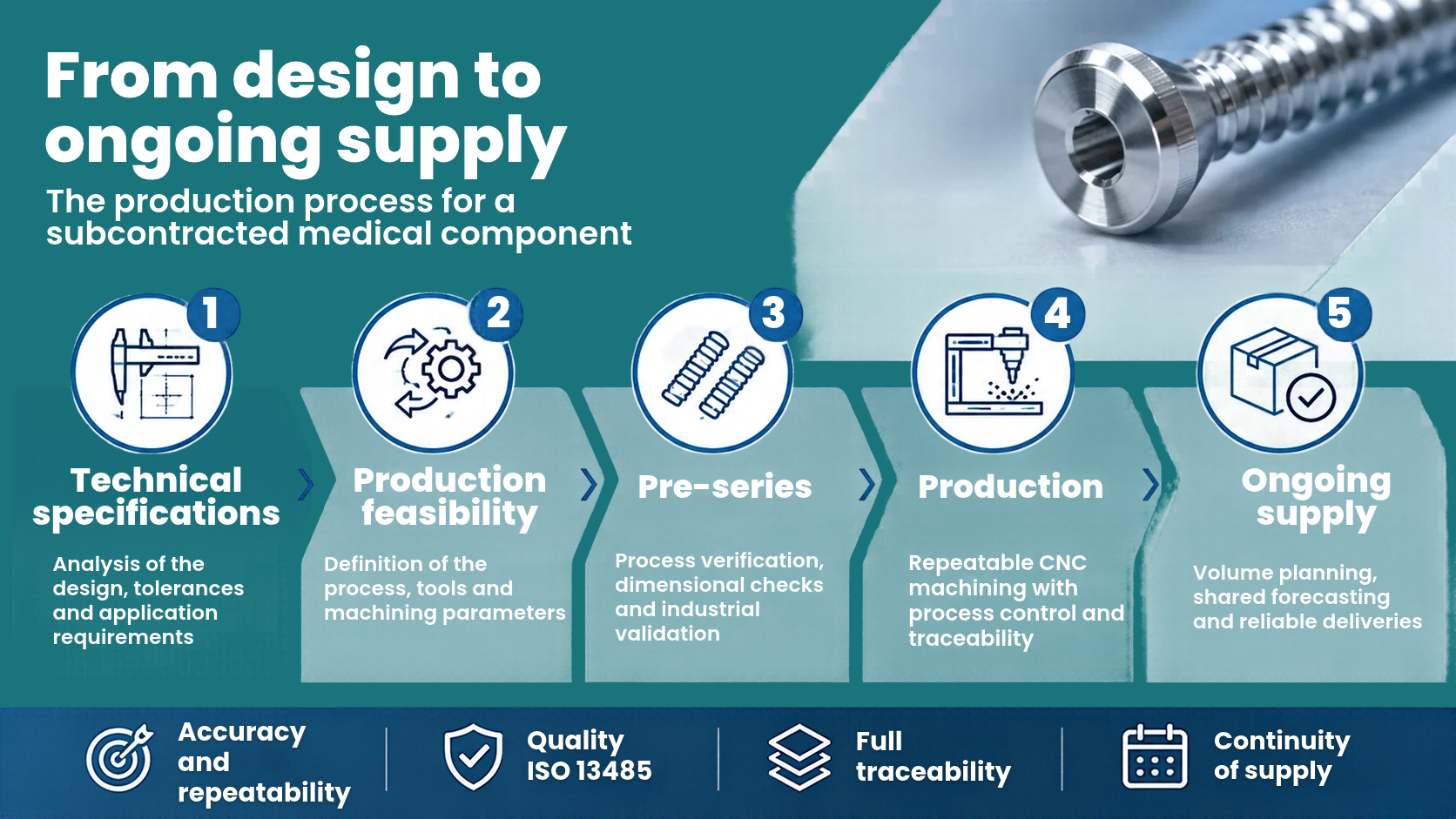
Choosing a medical component supplier means identifying an organisation capable of supporting a project not only during its initial stages, but throughout its entire production lifecycle.
Certifications, technical expertise, process control, traceability and production planning capabilities should be evaluated together.
At OROS, we manufacture precision micromachined components on a subcontract basis for companies operating in the medical sector, with particular expertise in the production of orthopedic screws, including cannulated screws, and other precision components for orthopedic and surgical applications.
Are you evaluating a new manufacturing partner or a second source for medical components?
We can discuss your technical specifications, expected production volumes and the conditions required to establish a reliable, ongoing manufacturing process.